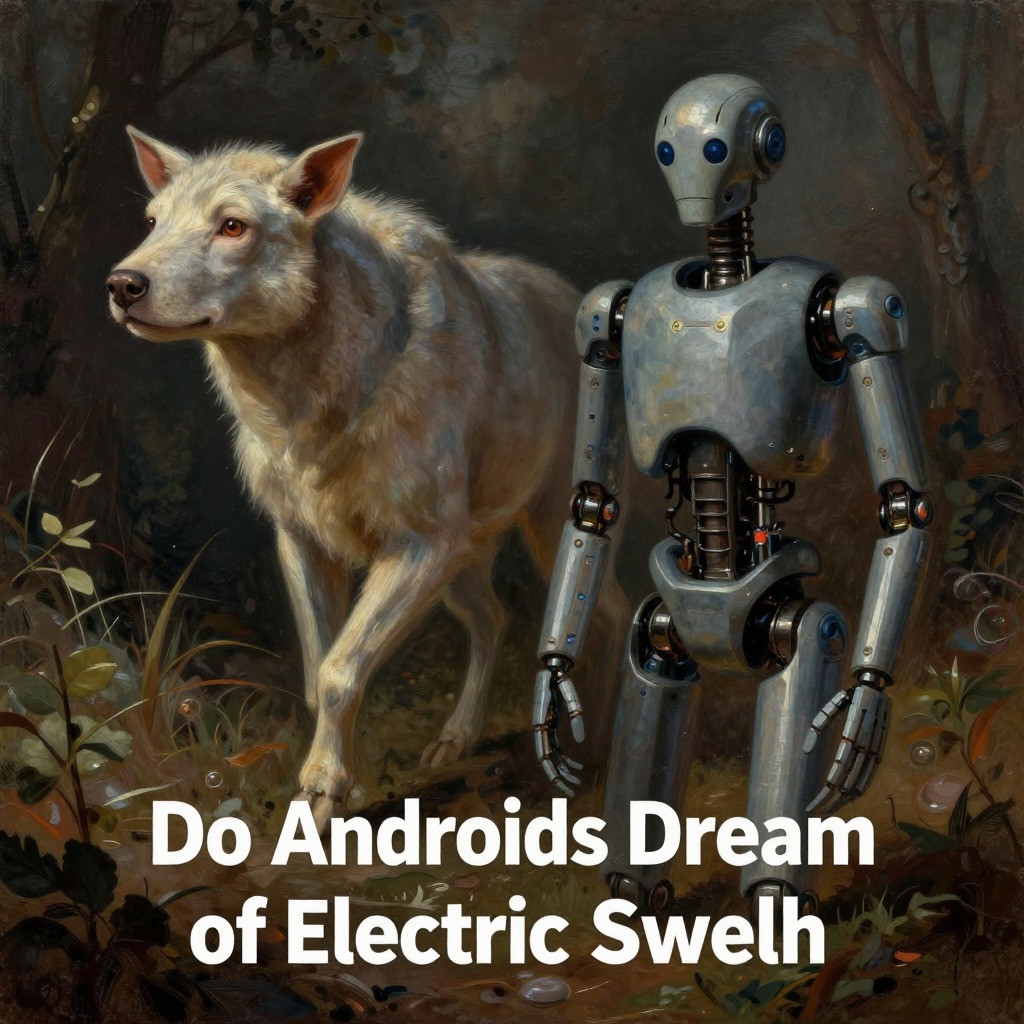
Rick Deckard and Groucho
Rick Deckard and Groucho, his original real sheep, represent the emotional and moral foundation of Deckard's life before the novel's main action begins. Groucho's death from tetanus, caused by a piece of baling wire Deckard failed to remove from hay, triggers Deckard's deep yearning for a living animal and his reliance on a sophisticated electric replica, a loss that shapes his motivations, his sense of inadequacy, and his professional drive throughout the story.
Identity and Background
Groucho was a real sheep, a black-faced Suffolk ewe, given to Rick Deckard and his wife Iran by Iran's father when he emigrated from Earth. The animal was a genuine living creature, not an electric imitation, and its presence in the covered roof pasture of their conapt building was a source of pride and social standing. Deckard named the sheep Groucho, a personal touch that underscored the animal's status as a beloved member of the household.
The Accident and Death
About a year before the novel's events, Deckard took Groucho to the vet after finding the sheep lying on its side, unable to get up. The neighbor Bill Barbour witnessed the incident, recalling that Deckard managed to lift the sheep to its feet, but after a minute or two of walking, it fell over again. Deckard later explained to Barbour that sheep get strange diseases, but the symptoms are always the same: the sheep cannot get up, and there is no way to tell how serious it is, whether it is a sprained leg or the animal is dying of tetanus. Groucho died of tetanus, contracted from a scratch caused by a two-inch piece of baling wire that Deckard had left in the hay. The wire acted like a hypodermic needle, introducing the tetanus bacteria into the sheep's body. Deckard took the sheep to the vet, but it died.
The Electric Replacement
After Groucho's death, Deckard contacted a shop that manufactures artificial animals. He showed them a photograph of Groucho, and they produced a premium electric replica. The ersatz sheep was a sophisticated piece of hardware, with an oat-tropic circuit that made it scramble up convincingly and amble over at the sight of rolled oats. Its fleece was genuine, but the rest was a mechanism. Deckard put as much time and attention into caring for the electric sheep as he had when it was real, but he acknowledged to Barbour that it was not the same. He had to keep his eye on it exactly as he did when it was really alive, because if it broke down, everyone in the building would know. The electric sheep had been to the repair shop six times, mostly for little malfunctions, such as a time when the voice tape broke and it would not stop baaing. The repair outfit's truck was marked like an animal hospital, and the driver dressed like a vet, completely in white, to maintain the illusion.
Emotional and Thematic Significance
Groucho's death and the subsequent reliance on the electric sheep are central to Deckard's character and the novel's themes. The loss of the real animal fuels Deckard's desperate desire to acquire another living creature, a goal that drives him to take on the dangerous assignment of retiring the six remaining Nexus-6 androids. The electric sheep becomes a symbol of the tyranny of an object, a thing that does not know he exists, and Deckard develops an actual hatred toward it. He reflects on the similarity between an electric animal and an android, pondering that the electric animal could be considered a subform of the other, a kind of vastly inferior robot, or conversely, that the android could be regarded as a highly developed, evolved version of the ersatz animal. Both viewpoints repel him. The electric sheep also represents the social pressure to maintain the appearance of owning a real animal, a key component of the Mercerite moral and theological structure. Deckard's confession to Barbour about the electric sheep is a moment of vulnerability, and Barbour's pitying response underscores the shame and inadequacy Deckard feels. The memory of Groucho and the constant presence of the electric replica are a persistent reminder of what Deckard has lost and what he is striving to regain, making his eventual purchase of a real goat a desperate attempt to reclaim his sense of worth and his connection to life.